Livia, Empress of Rome by Matthew Dennison
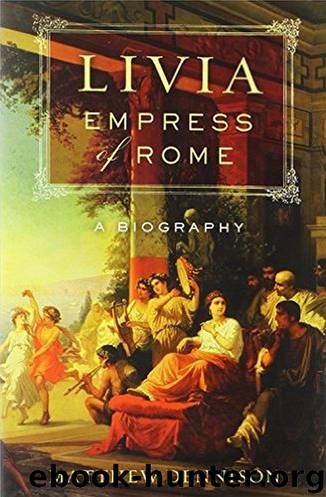
Author:Matthew Dennison
Language: eng
Format: epub, mobi
Publisher: St. Martin's Press
Published: 2010-01-01T05:00:00+00:00
We do not know if Livia was familiar with the example of Caecilia Metella, though it is possible. Among the causes of the outbreak of the Social War of 90 BC was the murder of the same Marcus Livius Drusus who adopted Livia’s father. Livia, like Augustus, restored a number of shrines and temples in Rome. Although her benefactions did not rival Augustus’s impressive tally of eighty-two temples renovated or rebuilt, it was a task she embraced early on. Even before Augustus’s settlement of 27 BC, Livia had restored the shrines of Patrician and Plebeian Chastity.6 For the remainder of her public life she would continue to favour religious sites associated with women. Among them were the Temples of Fortuna Muliebris (‘womanly virtue’) and Bona Dea Subsaxana (the ‘good goddess Subsaxana’), that cult whose all-female rites Livia’s kinsman Clodius had violated at the time of Livia’s birth in pursuit of an illicit assignation with Caesar’s wife.
Caecilia Metella is proof of the extent to which, even under the Republic, aspects of Rome’s religious life were considered an appropriate sphere for women’s interest. Roman religion was a crowded pantheon. Some of its deities personified abstractions, others were epic heroes and heroines on the grandest scale; several, like Fortuna Muliebris, specifically addressed concerns of one sex. Rome applauded religious observance, which had an active omnipresence in the city’s life on account of the daily practice of animal sacrifice – an offering of spilt blood and baked meats – common in many households. Religion permeated every aspect of the state’s life. Priesthoods, no less than magistracies, were offices for politicians. Many were male appointments, sacrifice being a man’s business. But prominent women won praise for their involvement with respectable Roman cults. Just as Caecilia Metella had ‘rescued’ the cult of Juno Sospita, so Augustus and Livia recognized in religion an aspect of Roman public life in which Livia could involve herself with impunity and even praise, to the ultimate benefit of her husband. That their instinct was correct appears to be proved by the record of Livia’s religious activities preserved in Ovid’s Fasti, the poet’s unfinished treatment of Roman legends structured around the religious festivals of the year. Far from attesting disapprobation, the Fasti applauds Livia’s efforts.7 Although the poem adopts an adulatory tone towards Augustus’s family, this does not negate its value as a source. That Ovid felt able to commend Livia’s religious activities within such a context indicates the extent to which they were considered both appropriate and laudable.
Livia benefited from Rome’s confusion of gods and family. In the aristocratic atrium, as we have seen, an altar served the lares – those divine spirits who represented a family’s ancestors and watched over their daily lives. In sacrificing to the lares, Romans made a show of pietas, a virtue understood in its broadest sense as respect not simply for the gods but also for the family itself.8 Roman women may have been responsible for overseeing the religious lives of their husbands’ houses. A
Download
This site does not store any files on its server. We only index and link to content provided by other sites. Please contact the content providers to delete copyright contents if any and email us, we'll remove relevant links or contents immediately.
| Africa | Americas |
| Arctic & Antarctica | Asia |
| Australia & Oceania | Europe |
| Middle East | Russia |
| United States | World |
| Ancient Civilizations | Military |
| Historical Study & Educational Resources |
The Daily Stoic by Holiday Ryan & Hanselman Stephen(3365)
The Fate of Rome: Climate, Disease, and the End of an Empire (The Princeton History of the Ancient World) by Kyle Harper(3091)
People of the Earth: An Introduction to World Prehistory by Dr. Brian Fagan & Nadia Durrani(2760)
Babylon's Ark by Lawrence Anthony(2721)
Ancient Worlds by Michael Scott(2719)
The Daily Stoic by Ryan Holiday & Stephen Hanselman(2710)
India's Ancient Past by R.S. Sharma(2493)
Foreign Devils on the Silk Road: The Search for the Lost Treasures of Central Asia by Peter Hopkirk(2482)
MOSES THE EGYPTIAN by Jan Assmann(2449)
The Complete Dead Sea Scrolls in English (7th Edition) (Penguin Classics) by Geza Vermes(2312)
The Earth Chronicles Handbook by Zecharia Sitchin(2258)
Lost Technologies of Ancient Egypt by Christopher Dunn(2255)
24 Hours in Ancient Rome by Philip Matyszak(2101)
Alexander the Great by Philip Freeman(2087)
Aztec by Gary Jennings(2057)
The Nine Waves of Creation by Carl Johan Calleman(1937)
Curse Tablets and Binding Spells from the Ancient World by Gager John G.;(1884)
Before Atlantis by Frank Joseph(1878)
Earthmare: The Lost Book of Wars by Cergat(1843)
